
The Most Expensive Problem In Freight Is The Time Between Knowing And Acting
In 2015, logistics latency nearly killed my brokerage. A decade later, most of it is still there.

Socrates believed most people suffer from answering the wrong question. Freight has spent twenty years asking how to collect more data. The better question is: why does it still take so long to act on the data we already have? That gap, the distance between knowing and doing, is what I’ve come to think of as latency, and it nearly killed my brokerage in 2015.
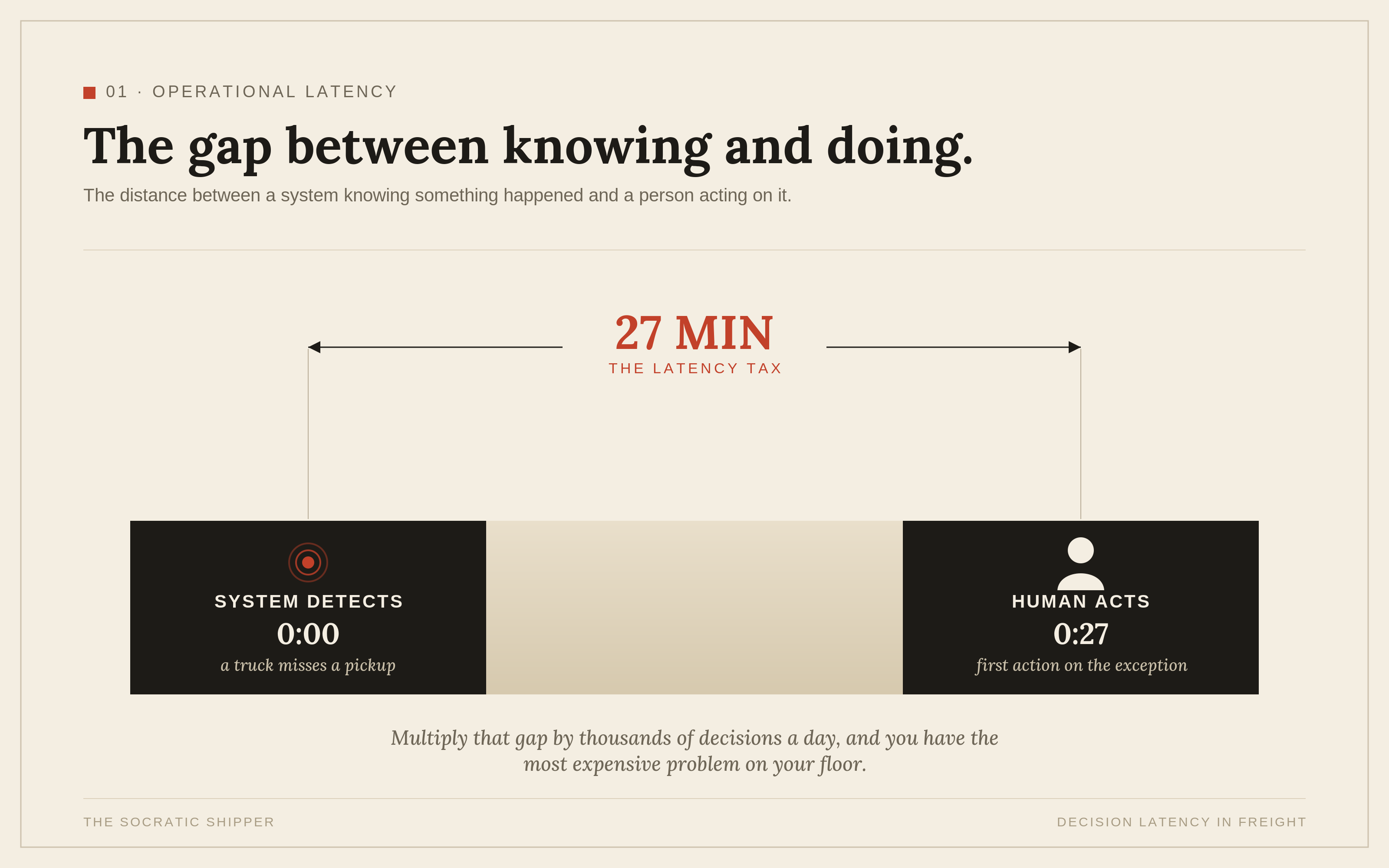
Operational latency in a freight brokerage is the gap between a system knowing something happened and a person actually doing something about it. A truck misses a pickup. The system flags it instantly. The first human action on it lands 27 minutes later. The 27 minutes are the latency. Multiply that gap by thousands of decisions a day, across every exception your shop processes, and you have the most expensive problem on your floor.
Markets move really fast in logistics. At the time, there wasn’t enough data in a sub-billion-dollar brokerage to predict when specific markets would move. We had a latency in understanding pricing. A latency in understanding capacity. Pricing latency and capacity latency were enough to keep me up at night.
Then came the latency of when drivers would send in proof of deliveries. The latency of when shippers would receive our billing and invoicing. People were still using the United States Postal Service for invoicing and billing. In 2015. We were one of the more sophisticated mid-market operators in the country.
I’ve watched the past decade carefully. Certain nodes have gotten faster. PODs come in the same day. Billing rides APIs that didn’t exist when I started. The overall network still isn’t operating fast enough. The operating model still isn’t able to change fast enough either, because the systems aren’t cooperating and connecting at the depth the market actually requires. So people can’t take action fast enough.
The same problem is still capping the margin of every brokerage I walk through in 2026.
Where latency hides today
It hides in specific places. Between a shipment being awarded and actually being booked. Between a carrier getting awarded a load and a broker verifying the carrier can actually haul it. Verification latency is a real number on a real P&L, and almost no brokerage tracks it.
It hides in the gap between thousands of calls and emails coming in concurrently and a human being available to respond. An LLM will always answer faster than a human will. Always.
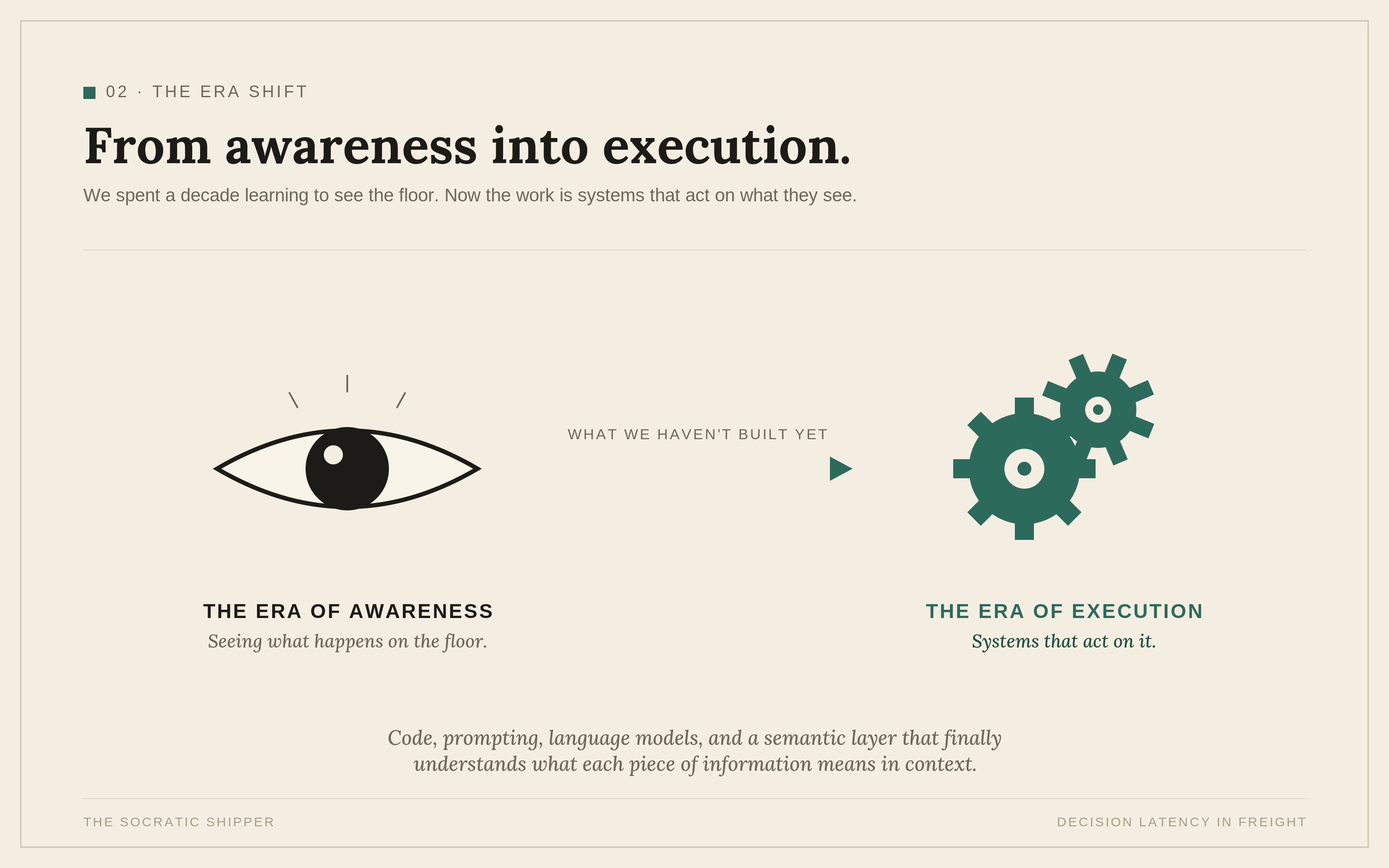
It mostly hides in the era we’ve been stuck in for the last decade. Michelle, who runs product strategy on my team, calls it the era of awareness. The era of visibility. We invested billions of dollars across the industry in seeing what was happening on our floors. We didn’t invest at the same scale in systems that actually act on what they see. We’re about to enter a different era. Awareness into execution. Awareness into systems executing, based on code, prompting, language models, and a semantic layer that finally understands what each piece of information means in context.
Some TMS platforms handed drivers load info on a mobile app and gave them rates back in 2016 and 2017. Big step at the time. Now we have engines that understand the ontology of why and how someone rates a specific load when a specific carrier calls in or emails from a specific location. The same shape applies to procurement, settlement, dispute resolution, and exception handling. Pricing is just the most visible node.
What this means for a CEO
Plain language. Across the table from a brokerage CEO, or a BPO operator running a 300-person ops floor, what is decision latency, and why should they care?
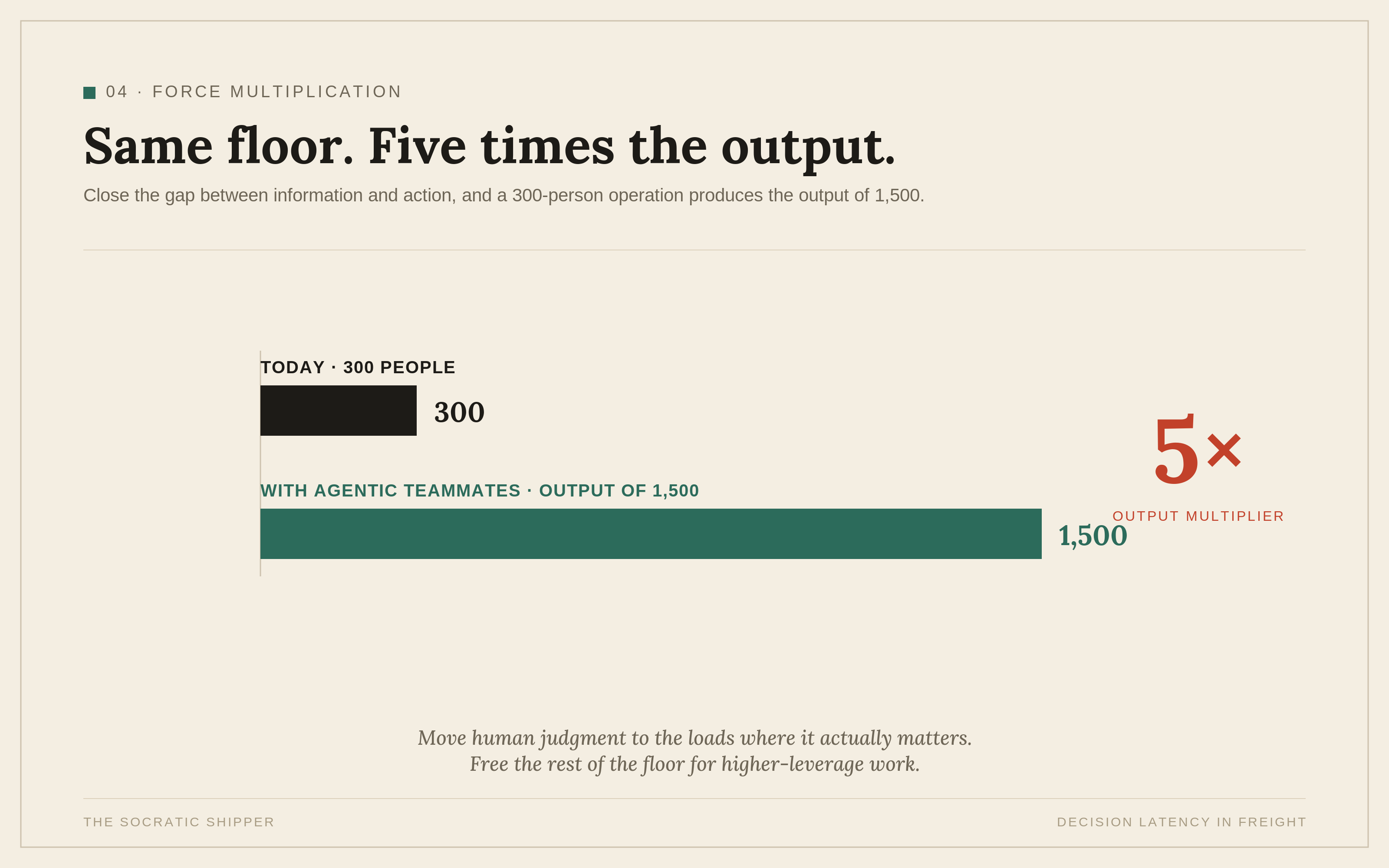
Imagine your floor today: hundreds of people managing thousands of micro-decisions on a loop. The reality is that the vast majority of these moves are bounded and entirely predictable. They don’t actually need the human judgment of the person executing them. When you eliminate decision latency across that mountain of repetitive work, you liberate your team for higher-level strategic challenges. I’m currently looking at a 300-person operation that could effectively scale to the output of 1,500 if they simply closed the gap between information and action.
Force multiplication at scale. Imagine your existing floor executing three to four times their current output by focusing exclusively on high-leverage challenges that actually demand human judgment.
The real CEO question is how to multiply what your workforce produces while doing right by the people on the floor.
The carrier rep’s day
What does a carrier rep actually do today that shouldn’t have to be this way?
The majority of what she does. Copy-pasting. Context switching. Posting loads. Taking them down. Inputting data into a TMS by keyboard. All of it disappears as the semantic layer gets built. The semantic layer is an operating layer. Not a TMS layer. Not a visibility layer. Not a payments layer. The agents will eventually be connected to one platform, and they’ll know all the specific rules based on historical evidence and on how the platform has learned to deal with, react to, decide, and execute in each situation.
Context switching doesn’t get talked about enough. Most leaders haven’t been on the floor recently enough to remember what it feels like to spend a day doing it. The fatigue is real. Control F, find a thing. Look at your files. Look at an email. Open Google Drive. Try to find the context for the thing you need to make the next decision about. It wears a team out. It treats your best people like search engines instead of decision-makers.
When you solve context switching, you’re creating a workforce cognitively able to do strategy work, customer-experience work, the kind of work no one on a board-watching floor has bandwidth for today.
Board watching
Human eyeballs glued to TMS screens all day long, waiting to take action. It’s wild if you actually go look at it. Eyeballs on the board, cortisol building, just looking at it, waiting to see what’s going to happen. Twenty-two to 30-year-olds sitting at their keyboards all day, watching the board, waiting to jam.
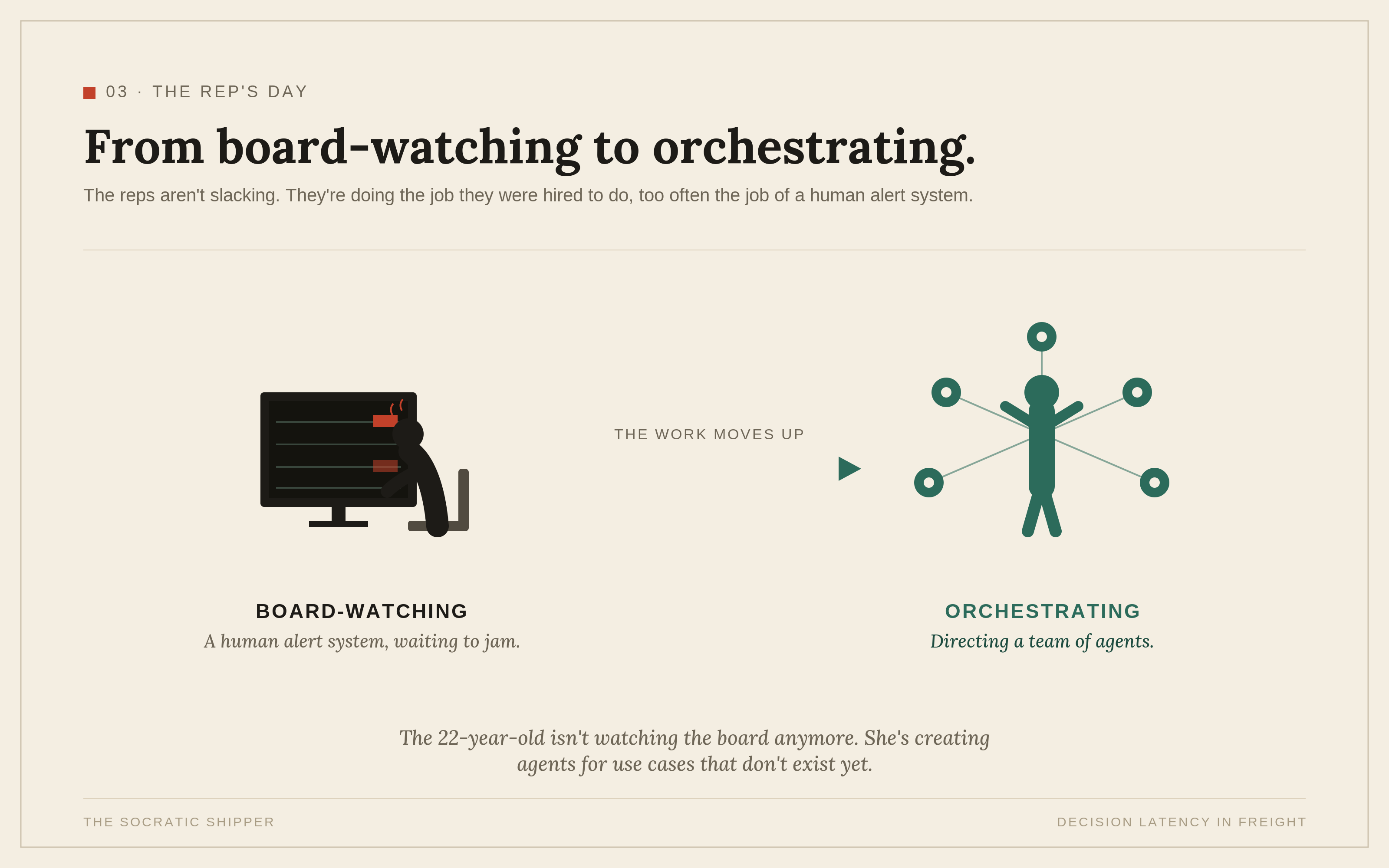
I’ve watched it on customer floors. I’ve watched it on competitor floors. I watched it on my own floor for years before I sold the business. The reps aren’t slacking. They’re doing the job they were hired to do, which is too often the job of being a human alert system.
The future is the agentic platform watching the screen. They’re part of the screen. They’re embedded in the screen. When something happens, they take action. The 22-year-old isn’t board watching anymore. She’s orchestrating. She’s creating more agents for use cases that don’t yet exist. The work moves up. The career moves up with it.
This isn’t about replacing human judgment. The judgment moves to where it belongs. Relationship building. Strategic account management. The customer call where the rate is the third most important thing in the conversation. The dispatcher’s decision that requires reading a person and not a number. You’re moving human judgment to the loads where it actually matters.
What it actually feels like to live this
One of our customers had a team whose jobs were almost entirely email and copy-pasting. Every day. All day. The same seven moves on a loop until quitting time.
We put agents on the seven moves.
The quality of life on the freight brokerage floor changed. The reps don’t want to go back to the old way. Copy-paste across multiple systems was how the work used to be done, and they’re done with it. The people on your floor know. They know the work they’re being asked to do isn’t worth their judgment. They’re waiting for someone to give them the tools to work at the level they were hired at.
So the question for you is how to take your existing workforce alongside your new workforce of agentic teammates. How to manage and level up your existing team. What other functions within freight would you have them perform? Higher-level work. Leaving their desks to actually visit the trucking companies they work with. Visiting the shippers. Building the relationships that compound. Instead of being chained to a keyboard, board watching all day.
The talent argument lands here. The brokerage that doesn’t keep its best people stuck in cognitive load and tactical workflow routing becomes a more attractive place to work. C players become B-plus players almost on day one because they’re no longer drowning in coordination work. The A players actually graduate into A-player work. You develop and attract talent simultaneously. The freight shop that wins this decade does both.
Three questions to sit with this week
Where in your shop does a system know something before a human does anything about it? Time the gap. Measure the average minutes between system detection and human action across your exceptions this week. Multiply by your typical exception volume. The total is your latency tax. Your finance team isn’t tracking it, and it’s bigger than you think.
How many hours of your top reps’ week are spent board watching? Pick three names. Look at an average week. The share of their day spent with their eyes on a TMS screen, waiting for something to happen, is the share of their salary you’re paying for software that doesn’t exist on your floor yet.
Are you patching, or are you building?
The Socratic close
What would Socrates say about decision latency in freight?
If you know there’s a latency problem, stop trying to patch the latency. Build a new substrate. Or at least sit with the question honestly. Are you patching your existing framework, or are you building for the future? Almost everyone in the industry right now is patching. Almost no one is rebuilding the substrate of how their floor actually operates.
Michelle McBride, Envoy’s Head of Product, reminded me of something from a philosophy class she took years ago. The lecturer’s point: people don’t fail because they lack information. They fail because they don’t know what to do with the information they have. The freight floor in 2026 lives that exact problem. The data is there. The dashboards are there. The alerts are there. The layer that decides what to do with all of it is what we haven’t built yet.
Socrates said: “There is only one good, knowledge, and one evil, ignorance.” Two decades into the visibility era, we are no longer ignorant. We know the moment a truck misses a pickup. We know the moment a POD is overdue. We know the moment a rate moves underneath us. Knowing alone doesn’t qualify as good. Knowledge that doesn’t act is knowledge that hasn’t done its job.
If you know there’s a latency problem, stop patching it. Build a new substrate.
I’m doing a fireside chat at the FreightWaves Supply Chain AI Symposium in Chicago. The session is called “The Transformation Era of AI in Freight: From Visibility to Execution.” If you’ll be there, find me before or after.
— Robby